Archives

Treatment of Nocturnal Enuresis using Yoga Prana Vidya Healing Protocols: A Case Study

Treatment of Nocturnal Enuresis using Yoga Prana Vidya Healing Protocols: A Case Study

Article link: https://ijpbms.com/index.php/ijpbms/article/view/231

Feb Issue link: http://ijpbms.com/index.php/ijpbms/issue/view/23

Authors:

Leelavathi Nayak, Certified YPV Healer & Trainer, Manglore, Karnataka, India

Dr. Venkata Satyanarayana Nanduri Consultant, Research & Publications, Yoga Prana Vidya Ashram, Sri Ramana Trust, Thally-635118 Tamil Nadu, India.

Abstract :

Introduction: Nocturnal enuresis, is night-time bedwetting in children five years of age or older, and is a common but disturbing condition causing psychological distress in affected children Though not considered as a serious health problem, several treatment options are available. This paper presents a case of Nocturnal enuresis suffered by a 7-year-old boy who was successfully treated using Yoga Prana Vidya (YPV) Protocols.

Method: Case study method is used in the analysis of this case, by collecting data from patient medical records, healer’s records and patient’s parent feedback.

Results: Within 14 days of YPV healing by the healer, gradually the frequency of urine pass at night sleep reduced. Also, it was found during follow up that the patient completely recovered and cured of this condition, and because of the holistic healing properties of YPV system and regular self- practices such as rhythmic breathing, forgiveness sadhana and Super-brain Asana, the patient grew up to be a normally healthy teenager without any health issues.

Conclusions: Integrated and holistic healing properties of YPV system protocols have been helping thousands of people to overcome physical, mental and emotional issues with sustained results when practiced consistently. Further research on this topic using appropriate methodology and sample size is recommended. It will be highly beneficial for all frontline healthcare workers such as doctors and nurses to acquire a working knowledge of YPV healing practices in combination with their respective specialties to holistically treat patients for sustainable results of cure.

Read More

A quantitative research study of the effects of Yoga Prana Vidya healing intervention on fatigue and subjective happiness of a sample of university students

A quantitative research study of the effects of Yoga Prana Vidya healing intervention on fatigue and subjective happiness of a sample of university students

Publications: World Journal of Advanced Pharmaceutical and Medical Research

Article link:
https://zealjournals.com/wjapmr/content/quantitative-research-study-effects-yoga-prana-vidya-healing-intervention-fatigue-and

Issue link :  https://zealjournals.com/wjapmr/ArchiveIssue-2022-Vol3-Issue2

Authors:

Raj Harsora, YPV Associate certified healer & YPV trainer, Ahmedabad, Gujarat.

Dr. Venkata Satyanarayana Nanduri, Consultant, Research & Publications, Yoga Prana Vidya Ashram, Sri Ramana Trust, Thally-635118 Tamil Nadu, India.

Abstract :

Introduction: Yoga Prana Vidya is an integrated and holistic system known to be effective in healing various physical and mental illnesses as complementary and alternative medicine. The objective of this study was to observe the impact of yoga prana vidya healing on the fatigue level and the happiness level of a sample of college students.

Methodology: The study design is pre – test and post – test method, with a sample of 25 participants. Quantitative data was collected using the Modified Fatigue Impact Scale (MFIS), and subjective happiness scale (SHS) and scoring the responses of the participants. A YPV healer was asked to give energy healing intervention to the participants through 5 sessions every alternate day over a period of 10 days. The healing consisted of sessions of 15 minutes of divine healing and few other supportive techniques. Data analysis was done using statistical techniques.

Results: Data analysis revealed significant reduction in the total fatigue levels. The physical and the psycho – social components were affected significantly, but the affect in cognitive component was not significant. In case of the subjective happiness level measured using SHS scale, analysis showed no change for the group, with 48% participants showing 16% increase and 52% participants showing 13.3% decrease.

Conclusions: YPV healing techniques caused significant reduction in the fatigue levels of the college student sample. In case of subjective happiness there was no significant change. One limitation of this study was small sample size. Further research using appropriate sample and methodology with longer and intensive intervention may be considered.
Read More

Successful Application of Yoga Prana Vidya Therapy Aad Energy Healing Techniques in De-Addiction: An Analysis of Case Series

Successful application of Yoga Prana Vidya therapy and energy healing techniques in de-addiction: An analysis of case series

Publications: International Journal of Integrative Medical Sciences

Article link: https://imedsciences.com/ijims-2022-101/

Authors: 

Neelam dube, 
YPV L1 Trainer, Indore & Melbourne, Australia.

Ramya Ashwin, 
Senior YPV trainer, Certified healer, Hassan, Karnataka 

Dr. Venkata Satyanarayana Nanduri
Consultant, Research & Publications, Yoga Prana Vidya Ashram, Sri Ramana Trust, Thally-635118 Tamil Nadu, India

Abstract :

Introduction: Human beings are afflicted by various harmful addictions of substance and non-substance cravings. Several behavioural therapies and medications are normally available for de-addiction and rehabilitation. Yoga Prana Vidya (YPV) is an integrated and holistic system that consists of no-touch no-drug energy healing protocols and simple to practice.This paper presents cases of various addictions successfully overcome using YPV System Protocols.

Method: This paper uses case study method going through case papers and feedback reports from subjects who had successfully overcome addictions using Yoga Prana Vidya system of protocols.

Results: An Indian sample of 30 documented cases shows that Yoga Prana Vidya healers applied YPV protocols for de-addiction of these cases successfully, and the 7 subjects who could be followed up confirmed that they successfully sustained the change. An in-depth case study of a subject in Australia healed by a YPV healer in Australia shows that the subject cured completely of alcohol addiction after 2 weeks of YPV healing. Further to it, this subject learnt YPV Level 1 healing and became a healer to continue healing himself and others as well.

Conclusion: YPV system is integrated and holistic, without touch or use of drugs. Decades of experience with YPV practice shows that many types of physical, mental and emotional illnesses have been cured successfully. YPV is easy to learn and simple to practice by all. Further research may be conducted on a larger sample of varied conditions of addiction to gain broader insights into this phenomenon.
Read More

A Pilot Study of the Effects of Yoga Prana Vidya (YPV) protocols on social behaviour, cognitive abilities and IQ of mentally challenged children

A Pilot Study of the Effects of Yoga Prana Vidya (YPV) protocols on social behaviour, cognitive abilities and IQ of mentally challenged children

Journal Title: A Pilot Study of the Effects of Yoga Prana Vidya (YPV) protocols on social behaviour, cognitive abilities and IQ of mentally challenged children

Publications : Med Research – Pediatric Review – International Journal of Pediatric Research-2021 Volume 8 Number 1 (January-February-2021)

Authors:

Dr. Rajkumari Khatri: Senior ENT & Head Neck Oncologist, YPV Trainer & Healer 247, Vikram Tower Sapna Sangeeta Rd, Indore(M.P.), India.-452007

Ms. Shilpa Bembalkar: Technical officer(B) ICMR National AIDS Research Institute, Pune, India.

Dr. Venkata Satyanarayana Nanduri: Research & Publications, Yoga Prana Vidya ashram, Sri Ramana Trust, Thally PIN 635118, Tamilnadu, India

Abstract :

  • Introduction: Mental retardation is a neuro developmental disability of children. In this pilot studythe authors have applied Yoga Prana Vidya system protocols for a pilot sample of mentally retarded children to study the effects and improvements in their being.

  • Objectives: To assess

    1. improvements of social behaviour, cognitive abilities and IQ,
    2. reduction in morbidity, and
    3. the effects on the frequency and duration of epilepsy attacks and seizures.

  • Design: This is a longitudinal study of 2 years duration mixed methods design using YPV intervention on a selected pilot-scale sample, collecting data on qualitative observations of social behaviour, and measurements of cognitive abilities and IQ pre and post-test for quantitative analysis.

  • Results: Statistical analysis of quantitative data revealed a significant increase in concentration, concept test, memory test,understanding, and social behavior. some increase in IQ and drawing test was present, however not found statistically significant. There was a reduction in the frequency and duration of epileptic attacks in epileptic children.

  • Conclusion: This study has demonstrated that the YPV modality of complementary therapy has great utility and scope in improving the social behavior, cognitive abilities and IQ of mentally challenged children. It is recommended that the earlier the intervention is conducted for the challenged children the better and sooner will be the better quality of life for them in terms of improved mental, emotional, and physical health. Further research with longitudinal full scale studies is recommended to investigate this phenomenon widely.
Read More

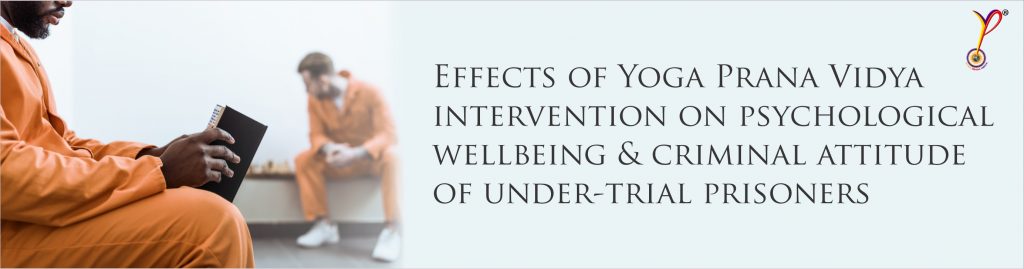
Effects of Yoga Prana Vidya intervention on psychological wellbeing and criminal attitude of under-trial prisoners

Effects of Yoga Prana Vidya intervention on psychological wellbeing and criminal attitude of under-trial prisoners

Journal Title: “Effects of Yoga Prana Vidya intervention on psychological wellbeing and criminal attitude of under-trial prisoners.”

Authors:

  • Venkata Satyanarayana Nanduri, Consultant, Research & Publications, Yoga Prana Vidya Ashram, Sri Ramana Trust, Doddabbanur, Thally, Tamilnadu, India
  • Revathi Ram, Yoga Prana Vidya, Practitioner and Inspector of Police, KSPS, Chitradurga, Karnataka, India
 
You might kindly recall that this project was originally conceived for The Department of Science & Technology – Science and Technology of Yoga and Meditation (DST-SATYAM) in December 2018, and also presented to their screening committee by Revathi during 2019. *DST did not grant funding this study, yet it was executed by Revati and Dr. VS Nanduri with support from Sri Ramana Trust, YPV Ashram.*


The publication took long time because of rigorous peer review system of this scientific Journal. They have given final acceptance on 31 Jan 2021 and published online straightaway. The editor said, this paper is very valuable for the theme of the Journal which is published online by Indian Society of Professional Social work (ISPSW).

Abstract :

  • Background: It is a general notion that rigorous isolation and custodial measures would reform the offenders of Law. Experience, however, contradicts this expectation and often imprisonment had the opposite effect. This study was conducted to test whether a known system of Yoga Prana Vidya (YPV) intervention can be applied for prisoners to increase their psychological well-being (PWB) and reduce the criminal attitude (CATS).

  • Materials & Method: Pre and Post-test without control group design was adopted for the present study. A mixed method was used to collect the data to see the effect of a 3-month YPV intervention on 30 under-trial prisoners. For Quantitative part of study Psychological well-being (PWB) and Criminal Attitude Test (CATS)were used before and after the intervention. Statistical analysis was conducted using IBM SPSS. Qualitative research interviews were conducted on 10 participants out of the 30 and the interview notes were analyzed.

  • Results: Statistical analysis of quantitative data showed that there was a significantly positive change in the PWB and CATS parameters after the intervention. The qualitative analysis yielded four themes:

    1. YPV is a positively Life-changing phenomenon, easy to practice daily,
    2. Clear Intention to sustain YPV practice after release from jail,
    3. Desirous of promoting, helping and recommending YPV to others to learn and practice, and
    4. Some challenges experienced by participants in the intervention.

  • Conclusions: YPV intervention produced positive results for prisoners who practised regularly. It is recommended that Government agencies and Social Workers may consider these findings for appropriate implementation of YPV in their Prison reform efforts for reducing crime rate and recidivism.
Read More

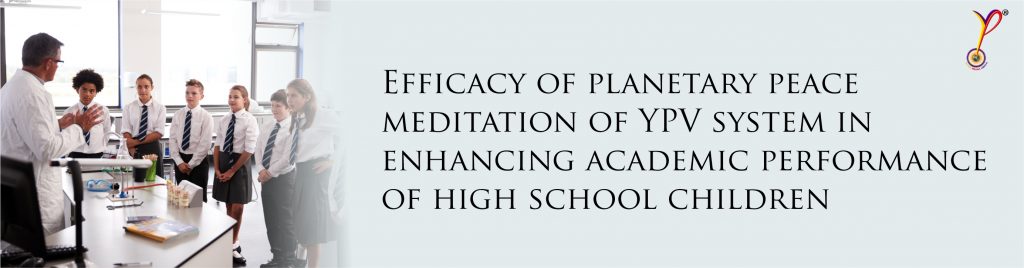
Efficacy of Planetary Peace Meditation of YPV System in Enhancing Academic Performance of High School Children

Efficacy of Planetary Peace Meditation of YPV System in Enhancing Academic Performance of High School Children

Journal Title: “Efficacy of Planetary Peace Meditation (PPM) of Yoga Prana Vidya (YPV) System in Enhancing Academic Performance of High School Children: A Case study.”

Publications: Indian Journal of Psychology and Education, 10 (2), July 2020, 59-64. ISSN -2231-1432

Authors: Ms. Ramya Ashwin, Ms. Poorna Kraleti, Dr. KVT Gopal, and Dr. V.S. Nanduri

Abstract :

Various factors inside and outside the school contribute for the level of academic performance of high school students, such as professionalism, skills and abilities on the part of the teachers; provision of library facilities, laboratory, appropriate teaching-learning processes and instructional strategies; effective communication between the individuals; formation of good terms and conditions and usage of technology and evaluation methods. The other factors tha influence the academic performance of the students are home environment, financial position of their families, conditions of poverty, provision of tuitions and assistance at home, counselling and guidance, occurrence of conflicts and disputes, potential employment opportunities, household chores, needs and requirements of other family members and occasional domestic violence and criminal acts. The attitude a student takes towards his/her education also is an important determinant of academic performance. Several studies have been reported on positive effects of meditation on student performance. The authors conducted this qualitative outcome study to explore the effects of planetary peace meditation (PPM) on the academic performance of 10th class students after 8 months of practicing PPM of the Yoga Prana Vidya System (YPV). The findings show positive influence of PPM on the SSLC examination results. This outcome encouraged the managements of other schools in the surrounding area also to adopt PPM in their daily programme. The authors conclude that despite methodological limitations in the study, there is prima facie evidence to show that the PPM process of YPV is highly useful in academic environment, and can be adopted in all educational institutions for better academic and overall results of students and the performance of teachers as well.

Read More

YPV Intervention at workplace for Corporate Employees and Executives

YPV Intervention at workplace for Corporate Employees and Executives

Journal Title:  ”A Study on the Effects of Yoga Prana Vidya System (YPV) Intervention at workplace for Corporate Employees and Executives to alleviate Anxiety, Depression and Burnout; and participants’ perceptions and experiences of the YPV Intervention.”

Publications: International Journal of Indian Psychology, 8(3), 374-390. DIP:18.01.047/20200803, DOI:10.25215/0803.047

Authors: Dr. V. S. Nanduri

Abstract :

Many employees of India’s Corporates are suffering from workplace anxiety, depression and burnout. Yoga Prana Vidya improves physical and mental health of people. This investigation aims to know the effects of a 3 months’ intervention on a sample of IT employees, using once-a-week, one-hour session, of physical and breathing exercises, forgiveness sadhana, and peace meditation. Anxiety, depression and burnout levels were measured pre and post intervention. Statistical analysis of quantitative data showed significant reductions in anxiety and depression with regular practice. Qualitative analysis showed that programme success is possible with management initiative and support. The impact felt is more with regular practice.

Read More

Leave Feedback